
Identify Who Owns a Monroe County Property
Three offices split the job in Monroe County. The Tax Assessor keeps the roll, the ArcGIS parcel layer maps each tract, and the Chancery Clerk records every deed. An address search is a start, never the proof.
- Search the street in Delta Property Link or the county Parcel Viewer.
- Copy the PPIN, full parcel ID, legal description, and deed book/page from the result.
- Check the named grantee and latest instrument in the DuProcess land-record index.
- If an LLC is named, keep the entity as owner and use the Mississippi business search only to understand the entity.
A parcel lookup in Monroe County works best when four facts agree. When the address, PPIN, legal description, and newest deed all point to the same tract, the ownership answer is solid.
Read Monroe County Owner and Address Fields Apart
Field names differ by system. The Delta detail calls the roll name OWNER, while ArcGIS labels it OWNERNAME. Mailing lines sit apart from SITUS_ADDR, STREET, and STREET_NUM. A tax bill can go to a post-office box, another town, or an agent. The parcel itself stays at the situs address.
Key terms: a quick gloss helps. Owner of record is the name on the stated public roll. A grantee is the party receiving an interest in a deed, situs marks the property location, and the mailing address is where tax correspondence goes.
No address field proves occupancy. Owner and mailing labels identify the parcel and the record recipient. Vacant tracts and estates show the gap.
Use the PPIN as Monroe County's Ownership Bridge
Owner names change, and road labels vary. The numeric PPIN is steadier. It works as a cross-office key between the assessor and the deed index. A public sample pairs PPIN 504 with parcel ID 0170-35-000-001.00, and its parcel card also lists section, township, range, a legal-description line, and a deed book and page.
Carry every identifier into the deed index. The full legal description beats a same-name match. That matters when one owner holds several tracts. Monroe County publishes no guide fixing the meaning of each parcel-ID segment, so keep the string exactly as it appears.
Note: A Nettleton mailing address may fall in Monroe or Lee County, so confirm the county before treating a PPIN as a Monroe record.
Where Monroe County Property Ownership Appears
Each source answers one question. The roll shows today's assessment. The deed index records each transfer, the GIS map ties the roll fields to a parcel polygon, and comparing them keeps one portal's update cycle from becoming the whole ownership answer.
| Source | Owner Info It Gives | Access |
|---|---|---|
| Tax Assessor roll | OWNER, mailing and situs fields, PPIN | Delta and Tri-State public lookup |
| Chancery land index | Grantor, grantee, instrument, book/page | Online index; courthouse official index |
| Parcel Viewer | OWNERNAME tied to a mapped parcel | Public ArcGIS viewer and CSV layer |
| Secretary of State | Business identity and registered agent | Official business search |
The Mississippi Secretary of State business search supports business name, ID, officer, and registered-agent queries. It can explain an LLC name. The deed remains the land-transfer record.
Check Monroe County's January 1 Roll Date
Monroe County's Tax Assessor redraws the ownership maps once a year. Each map reflects who held title on January 1. It also includes whatever legal filings the county had on hand. A deed recorded after that date can land in the Chancery Clerk's index. That can happen well before the next assessment roll catches up. The county publishes no official figure for that lag. So treat the roll date as a starting point rather than the final word.
After a recent closing, line up three dates. These are the instrument date, the recording date, and the roll's stated year. The Assessor's office at 662-369-2033 can say when a filed deed should show up. Until then, the newest recorded deed is the better clue about the transfer.
Fresh sale check. The name on the assessment roll may trail a recent deed. Verify the newest grantee in the official courthouse index.
See a Monroe County Owner Card in Context
The public Delta detail example shows one parcel record.
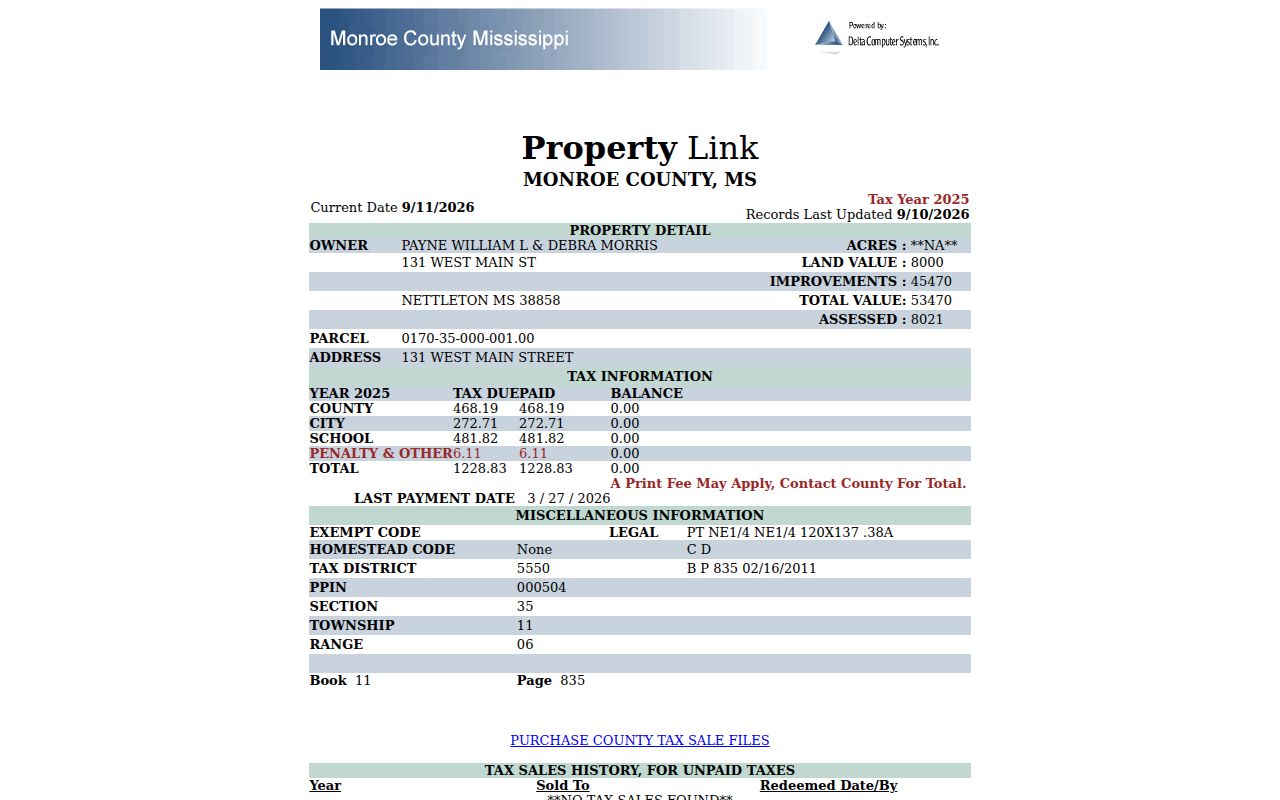
The sample earns its keep with the book/page bridge between the tax roll and the deed records. A tax page is not title proof. Occupancy cannot be inferred from it either.
Confirm Monroe County Ownership Beyond the Web
Online tools are only the first channel. Some answers need the counter. The Tax Assessor at 301 S. Chestnut Street in Aberdeen can clarify address spelling, PPIN, and annual-roll status by phone or in person. The Chancery Clerk at 201 W. Commerce Street maintains the official direct, reverse, sectional, deed, deed-of-trust, and plat indexes. Precision speeds any reply. A written request should identify the parcel ID, street, legal description, owner name, and desired year. Mississippi's Public Records Act permits clear requests for existing records, subject to exemptions and reasonable actual costs. Older ownership evidence may live in courthouse books. It may also wait in the MDAH microfilm catalog rather than online. Those volumes outrank any web display. Note: The DuProcess web index carries a warning about errors; the courthouse index remains Monroe County's official record.
What a Monroe County Owner Lookup Cannot Prove
A parcel label cannot clear title. It will not resolve an heir's interest, fix a legal boundary, or name every claimant. Trusts, estates, and entities can appear exactly as vested. Even a recorded deed may need legal interpretation. Use these results for purchase research, estate work, boundary questions, or civic review, then bring in a title professional when certainty matters.
Lawful use. Monroe County owner records support legitimate property research. Never use names or addresses to stalk, harass, intimidate, or harm anyone.
For the present roll field, see the current owner guide. For earlier transfers, the former owners route walks the chain of title backward.
Handle Monroe County Trust, Estate, and LLC Owners
An entity name changes one step, not the answer. The land record still shows whose name the parcel sits in. When a limited liability company appears, copy its exact spelling. Run that spelling through both the deed index and the Secretary of State file. A registered agent is a contact for the company. It is never a substitute owner. Trusts call for the same care. Keep the trust and trustee wording exactly as recorded. For an estate, Chancery probate filings may reveal the fiduciary authority behind a later transfer.
The deed itself settles most doubts. Its grantee line, signature capacity, legal description, and related instruments separate land vested in an entity from land tied only to a person connected with it. A deed of trust is not an ownership deed. It generally secures an obligation. Releases, substitutions, liens, and related filings can shape the record trail. They never name a new fee owner.
| Roll shows an LLC | Confirm the same entity as grantee and use the state business file for entity context. |
|---|---|
| Roll shows a trust | Preserve the trustee and trust wording; review the vesting deed. |
| Roll shows an estate | Check Chancery probate and fiduciary instruments for transfer authority. |
| Names differ | Compare PPIN, legal description, deed date, and the annual roll date before deciding. |
Careful naming does the real work here. It answers who owns a Monroe County property without turning an officer, trustee, heir, or mailing contact into an owner through inference alone.
Build a Verifiable Monroe County Property Owner File
Good ownership research leaves a trail anyone can repeat. Save the address form you used, plus the PPIN, parcel ID, roll owner, situs, tax-mailing fields, book and page, displayed year, and update date. Then record the newest deed's instrument reference, parties, recording date, and legal description. Agreement among those fields beats a name without context.
Trusts, estates, and companies need their exact recorded names. The Mississippi Secretary of State business search can clarify an entity name or registered agent, though it proves no fee title. Probate or Chancery records may explain an estate transfer. Every clue should lead back to the deed and parcel description before you name the owner of record.
After a recent sale, ask the Tax Assessor whether the January 1 roll has been updated. Ask the Chancery Clerk for the official instrument. Nettleton addresses need a county check first. A clean owner file keeps the tax-roll owner and the newest recorded grantee distinct. It states conflicts plainly, never picking the easy screen.
File the office confirmations with your dated search notes. Displays change. If a later refresh shifts the owner shown, the earlier record still reads correctly in its own time frame rather than looking like an unsupported error.