
Trace Monroe County Former Owners by Transfer
A backward deed timeline always opens with the newest conveyance you can confirm. Each match hands you the next name. The dates below describe source coverage, not a chain for any one house.
| Transfer era | Grantor to grantee evidence | Deed form | Locator |
|---|---|---|---|
| 1998 to present | DuProcess indexed parties and instrument details | Deed or related instrument | Instrument, book/page, parcel or legal fields |
| 1821 forward | Courthouse deed books and direct/reverse indexes | Recorded conveyance | Volume and page |
| 1821 to 1873 index | MDAH cataloged deed index | Historic deed entry | Index reference and volume |
| Selected years from 1822 | MDAH assessment images | Assessment evidence | Year and landowner entry |
Online work begins in DuProcess. Earlier former owners call for the Chancery courthouse index, MDAH microfilm, original-record finding aids, and accessible FamilySearch images.
Cross Monroe County's 1998 Online Line
The Land Title Association directory lists Monroe land records online. Coverage runs from 1998 forward. The county portal never states that start year. Confirm 1998 with the Chancery Clerk before treating it as a firm cutoff. The web index itself labels the courthouse index as official.
Coverage limit. A missing pre-1998 owner is not a missing deed. Continue in the courthouse books or archive microfilm.
In DuProcess, run a From Party search for the grantor and To Party for the grantee. Criteria cut same-name clutter. Date, instrument, book and page, parcel, legal, subdivision, block, lot, section, township, range, street, and PPIN fields can all narrow the results.
See the Monroe County Reverse-Index Screen
The official land-record application exposes the party-direction controls needed to reconstruct previous owners.
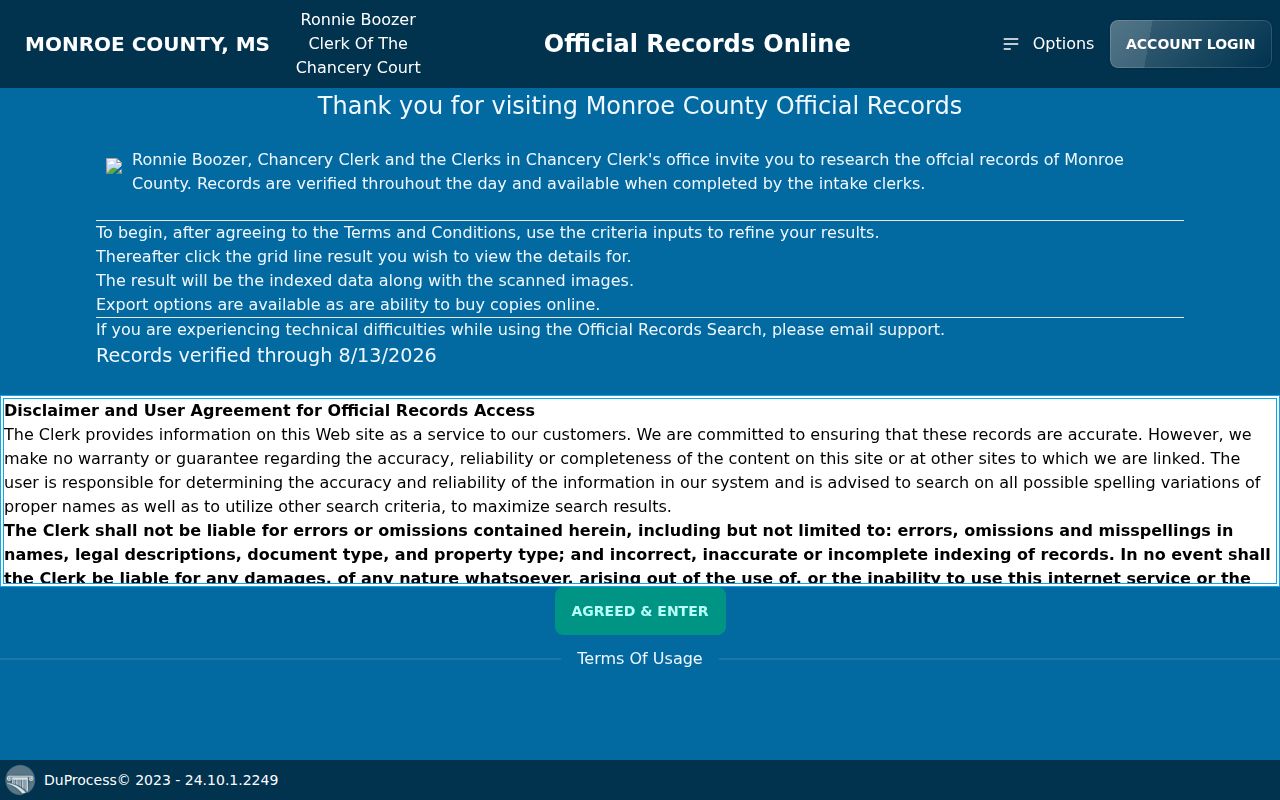
That screen is a search aid, nothing more. Log each matched instrument, then compare its legal description and parcel clues before stepping back another generation.
Walk Monroe County's Deed Chain Backward
Every link must connect the same land, not merely the same surname. Treat the latest grantee as your starting name and the latest deed's grantor as the next prior-owner lead.
- Open the newest deed and verify grantee, legal description, and book/page.
- Copy its grantor, who is the candidate previous owner.
- Search that grantor as an earlier grantee and match the same land.
- Repeat until the web coverage ends, then continue in the reverse index and deed books.
- Grantor / grantee
- The conveying party and receiving party.
- Chain of title
- The ordered sequence of instruments affecting the same land.
- Reverse index
- An index used to find deeds by the receiving party.
- Warranty / quitclaim deed
- Different deed forms whose legal effect should not be inferred from the label alone.
Continue Former Owners in Monroe Deed Volumes
Monroe's recorded depth starts with deed volumes 1 through 29, covering 1821 through 1902. An 1821 to 1873 deed index also sits in MDAH holdings. The MDAH county microfilm catalog sorts by county, series, and date. Filter it to Monroe first. Volume numbers, not surnames, organize the film.
The Media Room is self-service. Cataloged original county records and the Monroe finding aids open other routes. FamilySearch may restrict some images to an account or an authorized viewing site.
Note: Record every volume and page before switching media. That citation bridges the online chain and the microfilm.
Bridge Probate Breaks in a Monroe Owner Chain
Death breaks a clean grantor-grantee sequence. Chancery probate files can hold petitions, inventories, wills, orders, and fiduciary deeds that explain why heirs or an estate appear in the chain. Search under the decedent, the estate, the executor, the administrator, the trustee, and later grantee spellings.
Tax deeds open a different branch. MDAH Series 2050 holds Monroe sheriff tax deeds for property sold in 1869 and filed in 1871, with some redemption noted. Those entries mark forced historic events, not voluntary sales.
Match Old Monroe Land Without a Street Address
Older instruments rarely carry a street address. Expect section-township-range calls, quarter-section shorthand, metes and bounds, or a lot and block on a recorded plat, since no modern PPIN existed for the earliest owners. Compare adjoining owners, acreage, water or railroad references, and subdivision citations.
MDAH assessment images, in selected runs beginning in 1822, can place a landowner in a year between two deeds. They support the chain. They never replace the conveyance itself.
Measure Monroe County Ownership Time Depth
Monroe County was created in 1821, and its identified deed-volume run opens that same year. Depth on paper is not depth online. No parcel gets a guaranteed unbroken web trail. A sound history labels each proven transfer and each unresolved gap instead of forcing a name into place.
Lawful use. Former-owner research supports house history, estate work, and purchase diligence. Never use it to track or harass a living person.
For copies, use the Monroe deed records guide. The Chancery Clerk counter and its books remain the final local fallback.
Audit Each Monroe County Prior-Owner Link
A name in two indexes proves little. The entries may describe different land entirely. For every step, keep a compact chain log listing transfer date, grantor, grantee, deed type, book and page or instrument number, legal-description match, and any parcel key. Tag the source for each link. Note whether it came from the web index, a courthouse book, microfilm, an assessment image, a probate file, or the tax-deed series.
| Strong match | Same legal land, compatible acreage, adjoining-owner clues, and a direct grantor-grantee link |
|---|---|
| Needs review | Name matches but the legal description, parcel clues, or dates do not line up |
| Probate branch | Estate order, will, fiduciary deed, or heir transfer explains the change |
| Tax branch | Tax sale, redemption, or sheriff tax deed interrupts an ordinary sale sequence |
Corrections, quitclaims, and deeds of trust deserve special care. A correction may repair an earlier description rather than create a new former owner, and a quitclaim conveys whatever interest the grantor held without defining that scope. A deed of trust usually secures debt. Inserting the lender as a property owner would distort the chain.
When evidence stops, label the gap plainly. Return to the Chancery direct and reverse indexes, the MDAH original-record catalog, microfilm, digitized assessment runs, and probate holdings. This audit trail preserves honest time depth. Another researcher can retrace every claimed previous owner.
Request copies only after the chain log pinpoints the volume, page, instrument, and party in doubt, which keeps archive and courthouse work focused on the actual former-owner link.
Handle Breaks in a Monroe County Former-Owner Chain
A backward chain in Monroe County sometimes stalls when the expected grantee never shows up. The name may sit inside an estate file instead. A tax deed can break the pattern. So can a redemption, a re-recording, a name variation, or a tract split. Hold the legal description and the earlier book-page calls in view. Test the grantor in reverse. Reject any same-name match that carries different land.
Probate files can tie a deceased owner to heirs or to a court-authorized conveyance. Historic tax rolls place a name on land between deeds. Recorded plats explain how new lots came into being. These sources frame the gap but never substitute for the conveyance itself. For older chains, MDAH's early assessment series and Monroe deed volumes give concrete fallbacks. The 1821 to 1873 index helps too. So does the 1869 to 1871 sheriff tax-deed material.
Every link deserves a row: date, grantor, grantee, instrument type, book and page, the parcel or legal match, and where the record was viewed. Label any inferred bridge as an inference. When a FamilySearch image is restricted, keep its catalog citation and pursue the courthouse or MDAH copy. That discipline lets you reconstruct Monroe County former owners. It stops a family clue or tax hint from hardening into an unsupported title statement.
Copy names with initials, suffixes, trustee language, and entity punctuation exactly as recorded. Searching those variants can surface the next deed. Only a matching land description makes it part of the chain, though. This keeps a former-owner history from drifting onto a different Monroe County tract. Note rejected matches as well, so they are not chased twice.
Copy names exactly as the recorder spelled them. Keep initials, suffixes, trustee language, and entity punctuation in place. A search on those variants can surface the next deed in a Monroe County chain. Only a matching land description proves it belongs there. Without that check, a former-owner history can drift onto a different parcel entirely. Log each rejected match so the same dead ends are not chased twice.