
Fields in Monroe County Property Tax Records
The Delta Property Link puts assessment and billing detail on the same screen. Read every amount together with its year, district, exemption treatment, and refresh date.
| Field | What It Shows | Where |
|---|---|---|
| Land and improvements | Separate appraisal components | Delta and ArcGIS |
| Total value | Combined appraisal figure, not bill or sale price | Assessor roll |
| Assessed value | Taxable base after the statutory ratio | Delta detail |
| Exemption and homestead | Recorded tax treatment | Assessor fields |
| County, city, school, penalty | Bill components | Tax detail |
| Due, paid, balance | Dated account status | Collector-linked result |
Mississippi runs a two-step math. True value times the assessment ratio produces assessed value. Assessed value times millage produces the tax. Class I owner-occupied single-family real property carries a 10 percent ratio, while most other real property uses 15 percent. A deed price is evidence of one transaction. It is not an automatic match for the roll's true value, assessed value, or final bill.
Search Monroe's Delta Assessment Roll
Delta accepts a last-first owner name, separate address number and street, parcel number, section, township, range, or PPIN. Choose one strong criterion first. An owner name can lag a newly recorded deed because Monroe's annual roll uses ownership as of January 1 based on legal filings.
| Search field | Format | Best use |
|---|---|---|
| Name | Last first | Find an owner's roll parcels |
| Address | Number and street separate | Known situs |
| Parcel number | Full identifier | Cross-office match |
| Section, township, range | Separate fields | Rural tract |
| PPIN | County numeric key | Direct parcel result |
Open the official Delta property form and keep Current Date, Tax Year, and Records Last Updated.
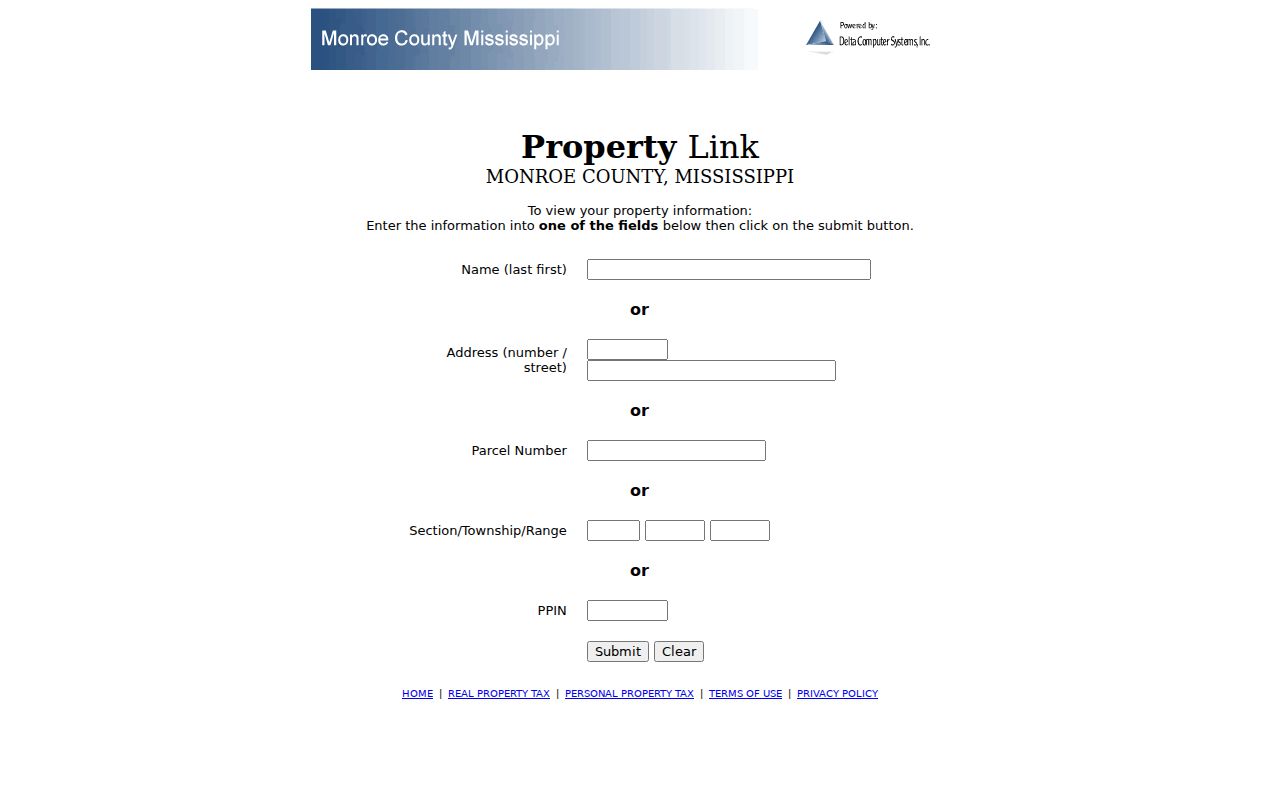
The separate inputs explain a practical point. A PPIN is often safer than forcing a rural tract into a street-address search.
PPIN 504 and Two Value Snapshots
One sampled Delta detail shows tax year 2025 with land value $8,000, improvements $45,470, total $53,470, and assessed value $8,021. County, city, school, and penalty lines totaled $1,228.83, with a zero balance and a last payment dated March 27, 2026. ArcGIS tells a slightly different story. It matches the land value but lists improvements of $43,540 and a total of $51,540. Resist the urge to average that mismatch. Preserve the source, year, effective year, and refresh date, then ask the Assessor which figure controls. Review the sample tax detail beside its capture.
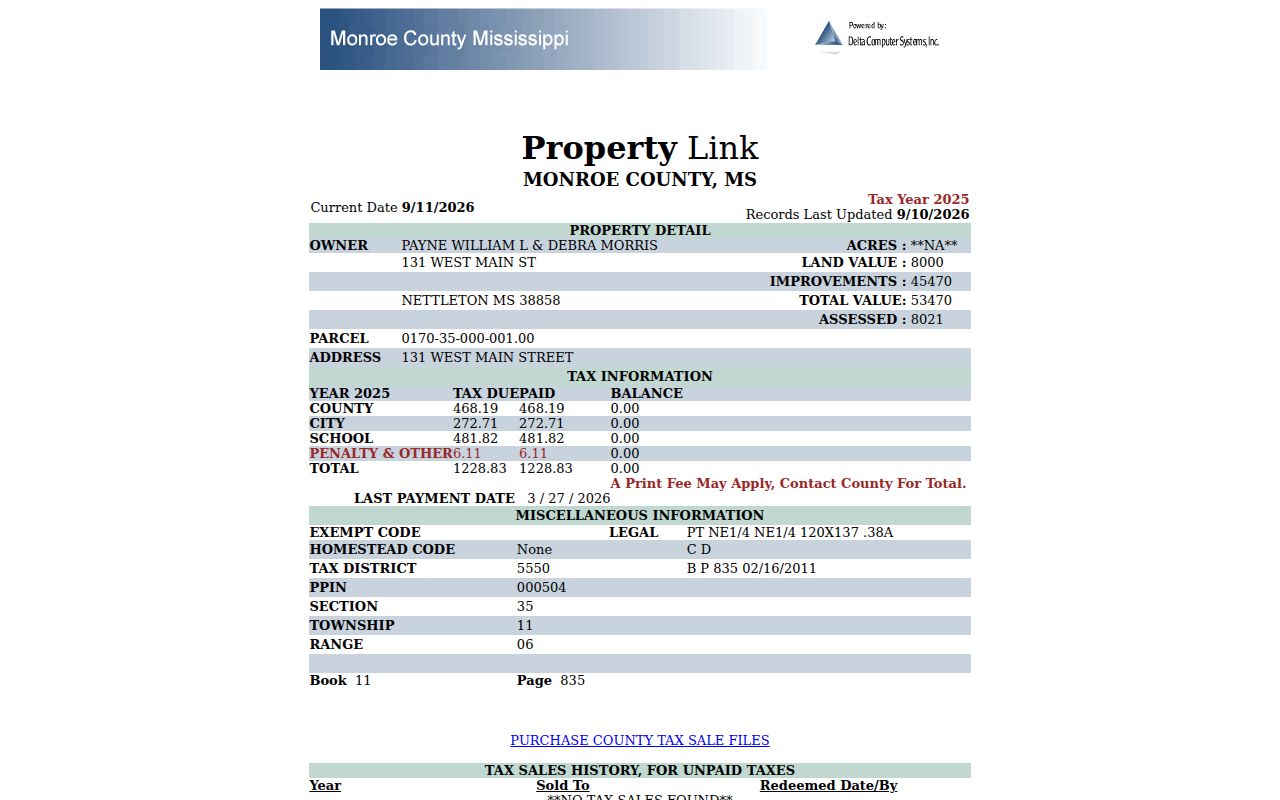
The screen connects it all to one parcel. Value, bill components, payment, legal description, and deed reference appear together, with dated context preserved.
Note: Delta displays a print-fee warning, so contact the county for the total before ordering printed output.
Monroe's January 1 Ownership Roll
Every year the Tax Assessor locates, lists, and values both real and personal property. The office also keeps the ownership maps current and sets the January 1 ownership from legal filings. That timing creates a small gap. A deed recorded after January 1 can appear in the Chancery index well before the roll shows the new name. The deed answers who transferred. The assessor entry names the tax-roll owner.
The roll changes annually for many reasons. New improvements, destroyed buildings, subdivisions, ownership shifts, and classification changes all drive the updates. Mississippi does require a real-property revaluation at least once every four years. Yet the assessor still maintains the roll each year regardless.
The April 1 Homestead Deadline
The Assessor helps homeowners file for homestead. The county sets April 1 as the deadline each year. Homestead and exemption codes shape how a property tax bill is calculated, but they cannot prove on their own that anyone actually lives there. For eligibility rules, required documents, and the correct filing year, call the Assessor at 662-369-2033 or visit the office at 301 S. Chestnut Street in Aberdeen.
- True value
- The appraisal basis.
- Assessed value
- True value after the class ratio.
- Millage
- The rate applied by taxing authorities.
- Homestead exemption
- Qualifying treatment requiring filing and approval.
- Tax lien
- A claim from unpaid tax, distinct from ownership.
Tax-Sales History for Unpaid Monroe Taxes
Delta detail carries a tax-sales history heading plus a link to the county tax-sale file. Work through it in order. Identify the PPIN, and inspect the balance and history. Then ask the Tax Collector for the delinquent year and amount. Ask the Chancery Clerk about the sale, purchaser, redemption, and any tax deed. Search the land records for later deed or redemption instruments too. Tax-sale status alone never settles current ownership.
Look Up a Monroe County Tax Bill
The Tax Collector's Government Window includes a Tax Bills option, while Delta supplies parcel-linked detail. Treat them as complementary views of the same account.
- Search Delta by one address, parcel number, or PPIN.
- Confirm owner, situs, legal description, tax year, and district.
- Read due, paid, balance, last payment, exemptions, and each component.
- Use Government Window for payment or contact the Collector for official history.
- Tax year
- The year the bill covers.
- Tax district
- The jurisdiction grouping behind levies.
- Balance
- The unpaid amount on the dated view.
- Payment portal
- A transaction path, not necessarily the full historical roll.
Counter, Phone, Mail, and Records Requests
Both the Assessor and Tax Collector sit at 301 S. Chestnut Street in Aberdeen. Call 662-369-2033 for classification, values, identifiers, homestead, or roll timing. Call 662-369-6484 for bills, receipts, balances, delinquency, and payment. A written request should include parcel ID, PPIN, street, owner, legal description, and year. Under the Mississippi Public Records Act, ask for maintained electronic historical rolls or nonexempt administrative records. Request a cost estimate as well. Older assessment material appears in MDAH collections.
County, City, School, and Penalty Lines
A Monroe tax total can blend county, municipal, school, and penalty components. Keep the district and situs jurisdiction attached to the figures. A postal city does not always identify the taxing city. A Nettleton mailing address may actually fall in Lee County. Confirm the county and parcel before comparing bills. A zero balance in one sampled year certifies nothing beyond itself. It does not clear every prior year, erase a recorded tax deed, or establish ownership. When due diligence depends on delinquency, redemption, or sale status, request the relevant year's official history.
Historic Monroe Assessments Before PPINs
MDAH Series 1202 lists assessment material from 1822-1841, plus selected land-assessment runs in 1843-1846, 1853-1854, 1857, 1868, and 1883. Series 2050 adds collector material and sheriff tax deeds. These records run on names, districts, and land descriptions rather than modern PPINs. Start with the archive catalog and identify a year and landowner. Then compare the entry against deed books and tax-deed material. Ask MDAH about microfilm or reproduction access rather than assuming every catalog item is downloadable.
Compare Monroe Tax Years Carefully
Put each tax year on its own row. Transcribe the land, improvement, total, assessed, exemption, district, due, paid, balance, and payment-date fields into separate columns so the years line up cleanly. A changed total rarely tells the whole story. It can reflect revaluation, construction, demolition, a classification change, or nothing more than source refresh timing. It does not by itself prove a sale. The deed reference settles transfer timing, and the Assessor can explain any roll adjustment behind the number.
Keep payment receipts and dated portal captures. For a payment question, the Collector's account record controls over an undated screenshot. For an assessment question, ask the Assessor which approved roll and value year apply. Keep payment fights apart from valuation appeals.
Prepare Evidence for a Monroe Value Review
Start with the parcel, not the dollar figure. Confirm the PPIN, parcel ID, situs, legal description, acreage, property class, tax district, and the separate land and improvement components. Then document the physical facts for the valuation year. Building size and condition, permitted additions, demolition, storm damage, access limitations, or a parcel split all belong in the file. Date each photograph and match it to its improvement. A neighboring assessment can supply context, but only when the parcels, improvements, classes, and valuation dates are genuinely comparable.
Ask the Assessor which record produced the figure. The fix may be a clerical correction, a classification or exemption issue, or a true valuation disagreement, and each path can use different forms and timing. Bring the Delta detail with its refresh date. Add any ArcGIS value snapshot, deed or survey information affecting acreage, and a written explanation of the requested correction. An asking price is not accepted evidence. Nor does an automated estimate carry the weight the local process requires.
Keep any payment dispute separate. Collect the bill, receipt, canceled-payment evidence, last-payment field, and Tax Collector correspondence. A corrected payment ledger does not revise assessed value. A successful value adjustment may still force the collector's account to be recalculated. Ask each office what follow-through occurs after a Board decision. Retain the written outcome with the affected tax year. This separation keeps a payment error from derailing a value appeal.
Note: Exact Monroe hearing dates and current forms must be confirmed with the Assessor for the active cycle.
Name the record you actually want. A mailed request should specify a current bill, payment receipt, delinquency history, annual assessment entry, homestead record, or Board action. Those are different records. Naming the year matters too. A current screen cannot answer a historical question, so ask for electronic delivery where maintained, approve substantial costs only after an estimate, and keep the response with the parcel's tax-year file.
Contest a Monroe County assessment. Start by preserving the tax year, class, land and improvement values, and exemption code. Also preserve the district, photographs, and relevant property facts. Ask the Assessor first. If unresolved, follow the Board of Supervisors equalization and appeal calendar under the Mississippi Department of Revenue framework. No dedicated appeal form or current hearing dates appear online.
Confirm the appeal window. Ask the Assessor for the active Board calendar and filing instructions promptly; do not infer a deadline from an older tax year.
Preserve the date behind Monroe County property tax records. A useful tax note records three dates: the tax year, the portal's update date, and the date the balance was checked. Dates anchor everything. Delta may show tax due, paid, balance, last payment date, and separate county, city, school, or penalty components. Government Window is a payment entry only. It never replaces the underlying bill. A pending payment, late posting, or corrected assessment can make a saved screen differ from the office's current ledger.
Keep valuation fields apart from collection fields. The Assessor sets roll values and exemption coding through the annual process; the Tax Collector bills and collects the result. Mississippi's true-value, assessment-ratio, and millage framework explains the calculation. A portal total is not a sale estimate. Homestead status belongs in the assessment file, even though its effect shows up in the tax result. Ask which year and roll control first.
For an appeal question, save the parcel card, value components, property classification, exemption field, and notice date, then ask the Assessor about the current administrative schedule. For payment or delinquency, give the Tax Collector the PPIN and tax year. Request the current amount or a receipt. For tax-sale history, confirm the sale and redemption record with the Chancery Clerk as well as the collector. Each office holds one piece. This division of duties keeps Monroe County property tax records from being read as one undated, all-purpose account.