
Documents Inside Monroe County Deed Records
The Chancery Clerk serves as recorder for Monroe County. Its shelves hold direct, reverse, and sectional indexes. They also hold deed books, deeds of trust, plats, liens, lis pendens, and tax-sale records. Nearly every land instrument filed locally passes through this office. The Monroe County Chancery Clerk page describes these holdings. The document type itself tells the story, showing whether a filing conveyed an interest, secured a debt, released a claim, or grew out of an estate, foreclosure, or tax process.
| Deed Type | What It Does | Common Use |
|---|---|---|
| Warranty deed | Conveys the stated interest with written title promises | Ordinary sale |
| Quitclaim deed | Conveys only the interest the grantor may hold | Family transfer or title cleanup |
| Deed of trust | Secures a debt against land | Mortgage financing |
| Trustee or executor deed | Transfers under trustee, estate, or court authority | Estate or foreclosure |
| Tax deed | Records a conveyance from the delinquent-tax process | Tax-sale property |
Deeds of trust often sit beside transfer deeds in Monroe County deed records. They answer different questions. Releases, substitutions, construction liens, judgments, covenants, easements, and plats all belong in the same reading as the conveyances before anyone draws a title conclusion.
Search Monroe Deeds in DuProcess
The DuProcess land-record inquiry searches party direction, dates, recording references, legal descriptions, addresses, parcels, and patents across Monroe County deed records. A PPIN or parcel ID helps first. So do book-and-page and instrument numbers, while names paired with date windows rebuild a longer chain.
| Control | Purpose | Search note |
|---|---|---|
| Grantor / From | Find what a party conveyed | Useful after identifying a prior owner |
| Grantee / To | Find how a party acquired land | Try entity and spelling variants |
| Dates | Limit crowded results | Recent 7, 30, and 90-day shortcuts appear |
| Instrument, book, page | Retrieve a known filing | Dynamic book lists may load |
| Parcel ID, parcel number, PPIN | Bridge from GIS or assessor | Retain zeros and punctuation |
| Subdivision, block, lot | Search platted land | Combine with party or date |
| Section, township, range | Search rural descriptions | Quarter controls refine the tract |
DuProcess results can display instrument number, type, status, page count, parties, parcel fields, related instruments, filer details, and document images. Legal-description and address columns can be toggled on or off. Exports run to Excel, PDF, or XML. Open the official Monroe land-record screen directly.
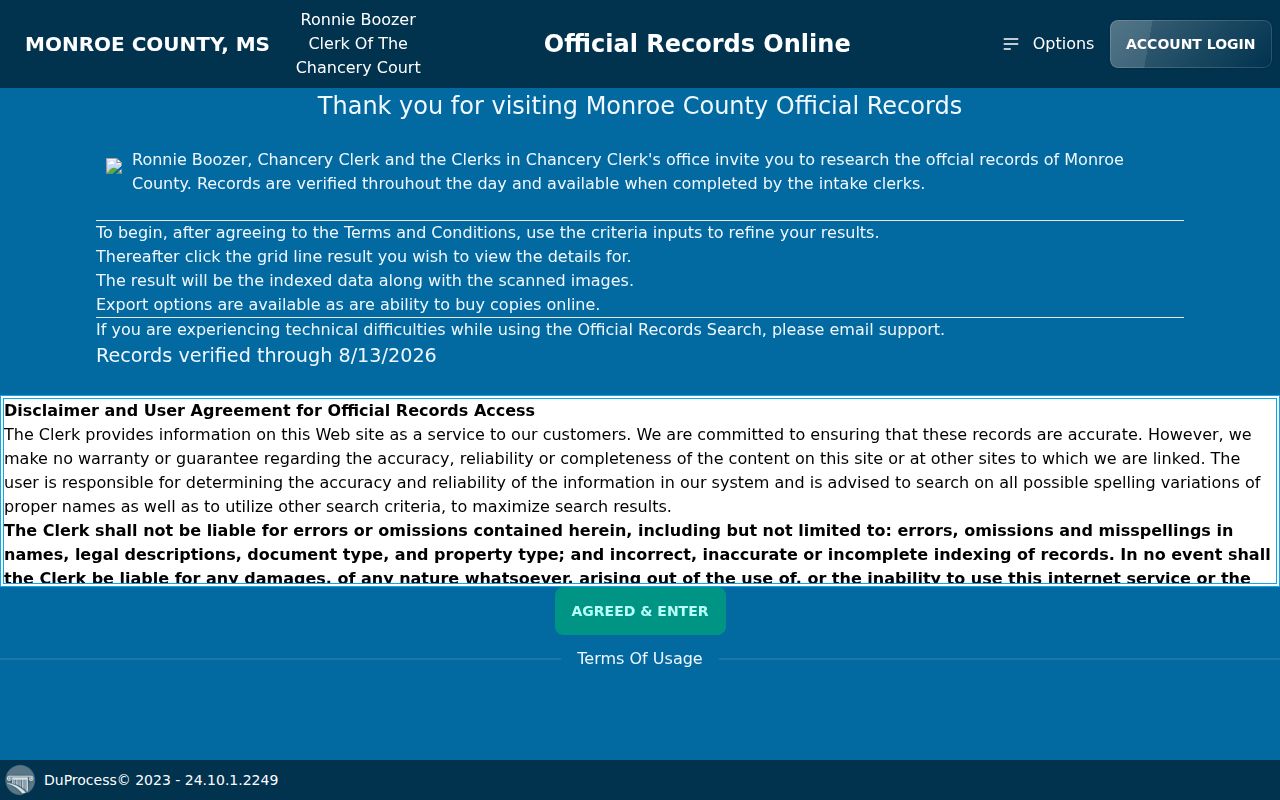
A party direction plus a parcel key beats a surname alone. The screen makes clear why unrestricted name searches muddy Monroe County deed records.
Note: DuProcess warns that the courthouse index, rather than the website, is the official index.
Monroe's 1998 Online Land-Index Window
The Land Title Association directory lists Monroe County land records online from 1998 forward, along with judgments and federal tax liens. The county portal itself does not state that starting year. Confirm it with the Chancery Clerk. An older deed can still exist.
Online versus official. The web index is an entry point. The courthouse index controls when completeness, certification, or older recording matters.
Walk Monroe County's Grantor-Grantee Chain
The direct index follows grantees. The reverse index follows grantors, so a Monroe County chain needs both, and the tax-roll owner is only a starting point until PPIN, parcel ID, legal description, acreage, and deed reference are compared to separate namesakes.
- Take the current owner and PPIN from the assessor, then search that owner as grantee.
- Open the newest plausible deed and compare every property identifier.
- Read its grantor, then search that party as a grantee in the preceding period.
- Repeat to the online cutoff, then move to courthouse or historic books.
- Grantor
- The party transferring the stated interest.
- Grantee
- The party receiving it.
- Chain of title
- The ordered sequence of instruments for one tract.
- Book/page and instrument number
- References used to retrieve recorded documents.
Monroe Deeds of Trust, Liens, and Releases
Monroe County deed records include deeds of trust, assignments, substitutions, releases, construction liens, federal tax liens, judgments, lis pendens, easements, covenants, and mineral or timber instruments. They also include plats. DuProcess related-instrument links show whether a secured claim was released. State tax liens are different. They moved to the state system after January 1, 2015. Entity and fixture filings may also need the Mississippi UCC search.
Monroe Deed Books Begin in 1821
Monroe County dates to 1821. So do its deed books. The MDAH county catalog describes records from that year onward, with finding aids naming volumes 1-3 for 1821-1836, selected later volumes through 29 for 1869-1871, and a deed index covering 1821-1873.
| Historic source | Span | Route |
|---|---|---|
| Volumes 1-3 | 1821-1836 | MDAH or FamilySearch microfilm |
| Selected volumes 4-29 | 1836-1871 | Archive and microfilm |
| Deed index | 1821-1873 | Older reverse-chain research |
Review the MDAH digitized Monroe series as another finding route.
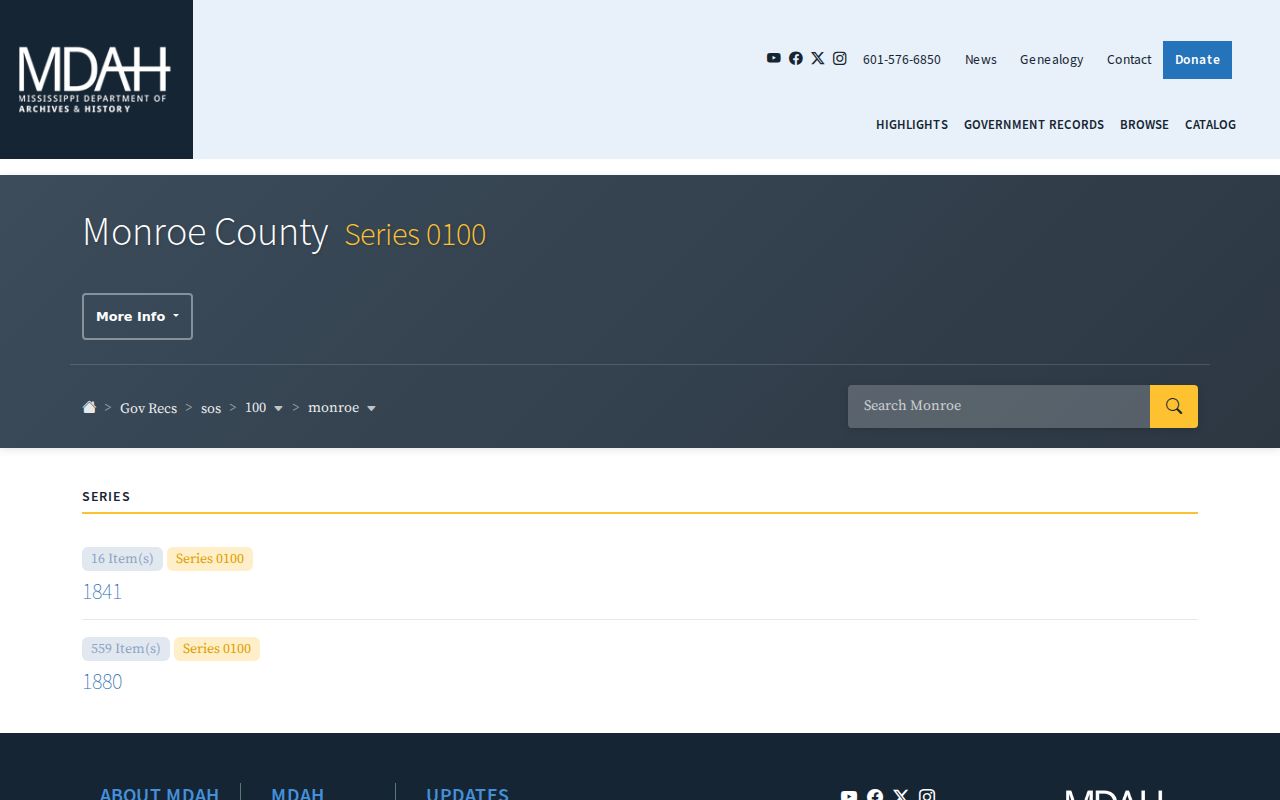
The archive page helps identify a series or item. It does not promise that every deed image is open remotely.
The 1869 Monroe Tax-Deed Trail
MDAH Series 2050 holds sheriff tax deeds for Monroe County property sold in 1869 and filed in 1871. Some parcels were redeemed. Sale, filing, redemption, and later instruments all matter. Modern tax-sale research likewise crosses the Tax Collector, the Chancery Clerk, the deed index, and redemption records.
Offline Routes to Monroe County Deed Records
The Chancery Clerk sits at 201 W. Commerce Street in Aberdeen and keeps the official index plus the older deed books. Call 662-369-8143 first. A mailed request should name parties, dates, parcel or PPIN, and legal description. It should also include any recording reference. Ask for a certified copy. Ask about cost too.
The Mississippi Public Records Act supports requests for nonexempt administrative records. Reasonable actual search, review, duplication, and mailing costs may apply. For older deeds, use the MDAH catalog, Media Room microfilm, and the archive request service. FamilySearch images may require an account or an affiliate facility.
Keep Names Tied to the Monroe Tract
A surname-only search can mix unrelated people, estates, trusts, and businesses in Monroe County deed records. Names repeat. Compare full legal description, subdivision or section, acreage, parcel keys, recording dates, and prior-book references at every link. Try entity spelling variants too. The state business registry helps when a grantee is a company. A mailing address may differ from the situs. Neither address alone puts a deed in the chain.
Probate can interrupt a neat sale-to-sale sequence. An executor deed, chancery decree, will, or estate sale explains how authority passed before a later conveyance, so ask the Chancery Clerk for the related file whenever a deed recites an estate, court order, or fiduciary capacity.
No Verified Monroe Deed-Alert Signup Yet
Monroe County offers no property-fraud alert signup. Mississippi Senate Bill 2751, introduced in 2026, proposed clerk alert systems and suspicious-document procedures by 2028. An introduced bill is not law. Owners can inspect recent deed index activity, contact the Chancery Clerk, and verify the bill's status themselves.
Verify Each Monroe Recording Reference
Start with a chain table, one row per instrument. Each row should carry the recording date, deed date, grantor, grantee, instrument type, book and page, and instrument number. Add the parcel ID, acreage, and the legal description word for word. Flag spelling variations and any deed conveying only part of the earlier tract. Parcels get split, combined, replatted, or renumbered. Identical names cannot cure a shifting description. Related-instrument links can expose corrections, releases, assignments, or later filings. Open and read every referenced item yourself.
Capacity matters when a party signs. A trustee, executor, administrator, conservator, company officer, and individual owner are not interchangeable roles. Authority may rest on a court order, an estate, a trust, or company action. In that case, obtain the supporting record from its custodian. A plat may supply the lot-and-block description. Retrieve the recorded plat rather than relying on a GIS outline. For rural land, keep section, township, range, and quarter references, dimensions, and exceptions exactly as written.
The question sets the stopping point. Purchase due diligence usually requires a professional search through the applicable examination period. Go past any unresolved exception. House-history work may continue through nineteenth-century deed books and assessment lists. An heir or estate question may branch into probate. State the goal before searching. The final collection then holds the instruments that answer the question, not simply every same-name result.
Note: A chain table is a research aid; only the instruments and official indexes supply the underlying evidence.
When a result cites a prior instrument, follow that reference even if the party search missed it. Spelling, filing direction, and parcel numbering shift across decades. A reference embedded in the deed may be the strongest route to a predecessor tract, a corrective instrument, an easement, or a reservation. Note why each item belongs in the chain. Note as well why each same-name result was rejected.
Order a Monroe County Deed Copy
DuProcess provides image and cart controls. Online card purchases are final. The portal adds a 3.5 percent service charge with a $2 minimum. The Monroe County Clerk can quote current plain-copy and certification charges. Before ordering, gather the instrument number, book and page, date, type, grantor, grantee, page count, and legal description.
Get the whole image. Exhibits may hold exceptions, easements, or the full legal description. At the counter, request the official index entry and the complete set of pages. By mail, send the same identifiers and specify certification and return method.
Recorded, not guaranteed. Monroe County deed records show instruments accepted for recording. They do not establish clear title, resolve every boundary, or account for unrecorded interests.
Reconcile Monroe County deed records with the parcel.
A name match grows stronger when the land matches, so compare the instrument's legal description against assessor and parcel-layer fields. Monroe County deed records may cite section, township, range, and quarter calls, or use acreage and dimensions. A subdivision entry adds lot and block. Preserve every exception, easement, and earlier book-page reference exactly as written. Those details separate adjoining tracts held by one owner. They explain the missing situs address, too.
The assessor layer supplies PPIN, parcel ID, deed book, deed page, deed date, legal lines, and situs, but treat it all as navigation aid. Open the indexed instrument itself. Confirm the parties, type, recording date, and description there. A deed of trust is not an ownership deed. A release points back to an earlier secured instrument. A quitclaim names the form of conveyance but promises nothing about clear title. Follow related-instrument links without assuming they resolve liens or title issues.
When online Monroe County deed records stop, take the last known grantee and legal description to the courthouse direct and reverse indexes. For nineteenth-century work, record the volume, page, date span, and archive citation from MDAH. Tax assessments and probate can bridge a deed gap. They stay supporting evidence, not substitutes. The Chancery Clerk's official index and certified instruments remain the local records to obtain for reliance. A title company or attorney must weigh the full chain, the exceptions, and enforceability.